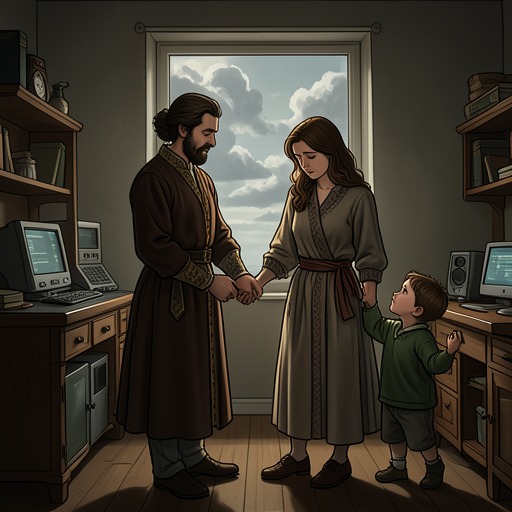
Stella and Gerry’s relationship
Midwinter BreakStella and Gerry’s relationship reaches a fragile turning point when Stella, having considered a future apart, makes the possibility of staying together conditional on Gerry giving up drinking. Their intimacy rests on a long shared life, but that history has not made their burdens equal: Stella names the repetitive household labor she carries, while Gerry’s drinking has become a source of self-hatred. The ending offers a renewed promise of care, expressed through a hand held, a request for flowers, and the prospect of planting them next year, without showing whether Gerry sustains his change.
A Shared Life and Unequal Daily Work
In a garden conversation, Stella describes marriage as a long duration with a comic lack of ceremony: if asked how long they have been married, she says, “For a protracted period.” The joke briefly draws them together, but it leads into a more serious account of what their shared life requires. She calls the relationship a pairing of “a flower and a gardener”: one person does the work, while the other displays. Her question to Gerry about which role each occupies makes the image an invitation to examine their balance, not merely a decorative metaphor.
Stella specifies the work behind that imbalance. Cooking, washing dishes, hanging sheets, and paying gas and electricity bills are tasks that must be done again; in contrast, Gerry’s work, as she frames it, produces something that may stand for hundreds of years. She invokes Virginia Woolf’s “Nothing remains of it.” The contrast is not simply between domestic and professional work: it is between labor whose results disappear through use and labor whose results remain visible. Gerry answers by pointing to his minestrone soup, but Stella brings the exchange back to its cost, noting the equipment still left to wash. When she asks who does the ironing, Gerry acknowledges that she does it, even as he questions the need to iron underwear and pyjamas. Their banter preserves familiarity while exposing how easily her recurring labor can be treated as ordinary background.
Separation as a Condition, Not a Threat Without Purpose
At the airport, Stella weighs separation against continued companionship. She thinks Gerry is kind and talented but has a drinking problem, and considers whether compromises could allow him to remain in her life. Her condition is explicit: that possibility depends on his being sober. She also reasons that her presence might make it more likely that he stays sober, while recognizing the risk of becoming his scold. The thought makes their interdependence plain, but it does not make her responsible for his recovery: she sees the change as something Gerry must believe is necessary because separation is real.
Her deliberation includes the possibility that Gerry, too, has been wounded by what happened to her in Belfast. She wonders whether his drinking is her fault and whether offering another chance would be a considered choice or simply a habit. These questions keep affection and injury in the same frame. Stella does not reduce Gerry to his drinking, but neither does she treat love as a reason to ignore it. The relationship’s immediate future turns on whether he can act on his promise to stop.
A Conditional Return to Each Other
When Stella comes back, she finds Gerry still in his seat and begins tidying the space around them: folding newspaper, pushing his bag beneath the seat, and dealing with a discarded coffee cup. Her practical instinct to make an encampment for them both accompanies the harder conversation. She says that, now an all-female religious collective is no longer an option, their home may not have to be sold if Gerry keeps his word about giving up drinking. The prospect is therefore neither a settled reconciliation nor a simple return to the old arrangement. It is a possible shared future, explicitly tied to sobriety.
Gerry responds to her appeal through their shared language of hope, completing the words Stella prompts: “All shall be well,” followed by “And all shall be well” and “And all manner of thing shall be well.” He then admits, “I hate myself when I’m drinking,” and, when Stella points out that he drinks all the time, answers, “So I hate myself all the time.” The exchange gives his dependence an emotional consequence in his own words; the promise to stop is connected not only to preserving their marriage but also to the self-contempt his drinking sustains. Stella offers to help him love himself again. In the same conversation, she says they should cherish each other because they do not have all that long, and translates that broad hope into a modest request: a bunch of flowers now and again.
Flowers, Time, and the Unresolved Future
The flowers become a small, concrete expression of what Stella wants from the relationship. She says she will plant them in autumn and that they will see the result next year. This is a plan that reaches beyond the airport’s immediate crisis, but it remains a hope rather than evidence that Gerry has stopped drinking. Its ordinary scale matters: care is imagined not as a single dramatic gesture, but as attention that can recur and a future they may tend together.
In the closing scene, Gerry and Stella sit beside one another in the snowy, stalled surroundings and look toward a light they first mistake for an approaching plane. They decide it is Venus, and Stella associates the planet with the Roman goddess of love. Gerry imagines the past landscape beneath the modern buildings and snow, then returns to the present beside Stella. Her presence seems to him a privilege, as important as the world and the stars around it; to pass through life at her side feels like a miracle. This final valuation answers the earlier image of the flower and gardener with recognition rather than a division of roles. Yet the scene confirms tenderness, not the outcome of Gerry’s promise. The relationship ends poised between the injury of repeated drinking and the possibility that mutual care, made concrete and conditional, can continue.